Leave a Patch Wild: How a Wildflower Corner Can Help Save Britain's Bees
UK insect populations have declined by up to 60% since the 1970s. One of the simplest things you can do? Stop mowing a small corner of your garden.

In 2023, a major study published in Nature confirmed what ecologists had been warning for years: flying insect populations in the UK have declined by up to 60% since the 1970s. Bees, butterflies, hoverflies, moths — the creatures that pollinate our crops, feed our birds, and hold ecosystems together — are disappearing at a rate that should be keeping politicians awake at night [1]. It isn't.
The causes are well-documented. Intensive agriculture. Habitat loss on an industrial scale. Pesticide use. Climate breakdown. But one factor that rarely makes the list is the cumulative effect of millions of domestic gardens being mowed, sprayed, and tidied into ecological deserts.
The UK has roughly 24 million gardens, covering an estimated 400,000 hectares — more than all the country's nature reserves combined [2]. What happens in those gardens is not trivial. It is, collectively, a landscape-scale decision about whether insects get to live or not.
The simplest useful thing you can do
You don't need to rewild your entire garden. You don't need to dig up your lawn or buy expensive wildflower turf. The absolute simplest thing you can do is this: stop mowing a small corner.
Pick a patch — it can be as small as two metres square — and leave it alone. Don't mow it, don't strim it, don't spray it. Let whatever's in the soil come up naturally.
Within weeks you'll see grasses growing tall, clover flowering, dandelions going to seed. Within a season, you'll likely find buttercups, daisies, self-heal, and bird's-foot trefoil — native wildflowers that were in your soil all along, suppressed by regular mowing. Research by Plantlife found that simply reducing mowing frequency can increase flower abundance by up to 400% and nectar production tenfold [3].
Within a year, that patch will be humming with life. Bees, hoverflies, butterflies, beetles, ladybirds, spiders — an entire micro-ecosystem, created by not doing something.
How to make it work without looking neglected
This is where most people get stuck. They're worried it'll look like they've given up. The secret is managing the boundary: a clearly defined wild area within a tidy garden looks deliberate and beautiful. A forgotten corner that blends into an unmowed lawn looks like you've gone on holiday.
Here's what we recommend at Albyn Fieldworks when customers ask us to leave a wild patch:
- Choose a sunny spot. Wildflowers need at least four to six hours of direct sun. A south or west-facing corner is ideal.
- Define the boundary clearly. Mow a crisp edge around the wild patch. This single detail transforms the perception from "neglected" to "designed."
- Mow a path through it. If the patch is large enough, cut a narrow path through the middle. This gives you access, adds visual structure, and creates edge habitat — ecologically the most productive zone, where mown and wild areas meet.
- Cut it once a year. In late September or October, cut the patch down to about 10 centimetres. Leave the cuttings for a few days so seeds can drop, then rake them off. This mimics traditional hay meadow management — the method that sustained Britain's wildflower meadows for centuries before intensive farming destroyed 97% of them.
- Or cut on a higher setting. If full wilderness isn't your style, we can cut that area at the highest mower setting — around 8 to 10 centimetres — every four to six weeks. Low-growing flowers like clover and self-heal will persist and bloom at this height.
The key point: your garden can be both tidy and ecologically valuable. You don't have to choose.
What you'll find growing
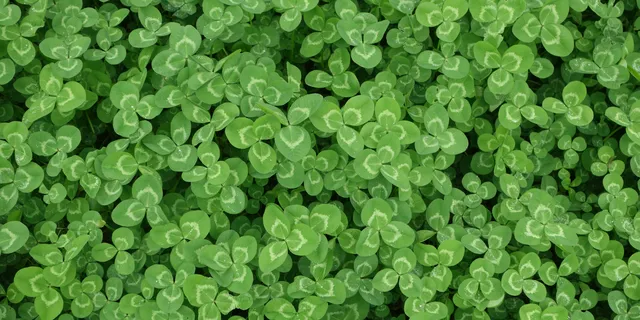
In a typical Aberdeen garden, leaving a patch for a full season is likely to produce white clover (excellent for bumblebees), red clover (deeper flowers, favoured by long-tongued bees), dandelions (one of the most important early-spring nectar sources — don't spray them), buttercups, self-heal (Prunella vulgaris, a native with purple flowers beloved by bees), and bird's-foot trefoil (bright yellow, an important food plant for several butterfly species).
If you want to accelerate things, scatter native wildflower seed in spring. Look for mixes designed for your soil type — in Aberdeen, a clay-loam mix will suit most gardens. Avoid mixes heavy with non-native annuals like cornflowers and poppies if you want something that sustains itself long-term. Scotia Seeds and Wildflower Farming both sell mixes appropriate for Scotland.
The bigger picture
A single wildflower patch in a single garden won't reverse the insect decline. But if even a fraction of the UK's 24 million gardens left a small corner wild, the cumulative effect would be extraordinary — a network of habitat corridors connecting parks, hedgerows, and green spaces across the country.
The wildlife charity Buglife calls this the B-Lines initiative: a proposed network of wildflower-rich pathways across Britain, linking existing habitats. Your garden can be part of it. It costs nothing. It saves you mowing time. It looks good if you manage the edges. And it might, in aggregate, help keep the pollinators that our food system depends on from disappearing entirely.
As George Monbiot has written: the crisis in nature isn't happening somewhere else. It's in the soil beneath our feet and the air above our lawns. What we do with our own small patches of ground is one of the few things we actually control.
If you'd like Albyn Fieldworks to leave a wild patch when we cut your grass — or help you establish one — just mention it when you book. We'll keep the rest tidy and give the insects somewhere to live. It's not complicated. It just requires the confidence to leave a small corner alone.
Notes
[1] The 60% decline figure is drawn from long-term monitoring by the UK Centre for Ecology & Hydrology, synthesised in van Klink, R. et al., "Emerging technologies revolutionise insect ecology and monitoring," Nature, 2023. The State of Nature 2023 report provides the UK-specific context: one in six species is now at risk of extinction in Britain.
[2] The 400,000 hectare estimate for UK garden area comes from the Royal Horticultural Society, drawing on ONS and Ordnance Survey data. For context, the total area of UK Sites of Special Scientific Interest is approximately 2.4 million hectares — but most of that is upland or marine, not the lowland habitat that pollinators depend on.
[3] Sherlock, O. et al., "The impact of mowing frequency on plant species diversity and pollinator abundance in urban grasslands," Plantlife, 2019. The study found that cutting frequency was the single most important factor determining flower abundance and nectar production in domestic lawns. The ideal regime for nectar was cutting once every four to eight weeks and removing clippings.
Albyn Fieldworks
Local gardener in Aberdeen & Aberdeenshire